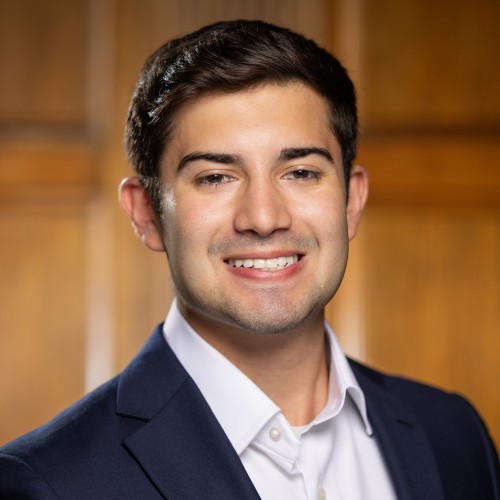
Sebastian Romero
This training will make me a more effective physician by allowing me to make decisions with both clinical and structural implications in mind. I’m learning how teams function, how to communicate across disciplines, and how to evaluate problems through a systems lens, skills that will serve me in clinical work, quality improvement, and future leadership roles.
I’m currently an EMT with Cataldo Ambulance and a strategy and research associate at Antares Therapeutics in Boston, MA. I studied molecular biology and global affairs at Yale University, where I also completed a certificate in global health. My interests lie at the intersection of clinical care, healthcare economics, and healthcare systems/policy. This year, I’ll be applying to medical school with long-term goals of building a career that spans medicine, hospital leadership, and venture-backed innovation.
Outside of work, I enjoy going to the gym, playing pickup basketball, fishing, and mindlessly watching YouTube Shorts docuseries. I also love visiting new cities, and on weekends, I’m usually trying a new restaurant or catching up with friends and mentors.
What drew you to pursue an MHA degree?
I was drawn to the MHA as a way to better understand how health systems operate and how to lead teams, manage strategy, and drive innovation from within. I feel the complement between Tuck and Geisel provides a solid understanding of healthcare economics and management that will aid my future medical training. My long-term goal is to practice medicine, while contributing to healthcare delivery transformation through clinical leadership, operations, and biotech strategy.
Why Dartmouth?
Dartmouth’s MHA stood out because of its deep connection to healthcare delivery science and its intentional focus on leadership rather than purely administrative training, especially with a focus on designing equitable health systems. The blend of Geisel’s clinical and population health perspective with Tuck’s rigor in strategy, economics, and organizational behavior felt uniquely aligned with my goals.
I was also drawn to the program’s immersive and intimate cohort model. Coming from clinical work and research environments, I wanted a graduate program where collaboration, mentorship, and real-world problem-solving were core components rather than add-ons. Dartmouth’s emphasis on mission-driven leadership, thoughtful pedagogy, and applied learning made the decision feel natural.
What has been the best part of the program for you – so far?
The best part of the MHA program has been the opportunity to build genuine relationships with my cohort during our residential sessions in Hanover. Some of my favorite moments have happened outside the classroom, sharing dinners together, exploring Hanover, and talking late into the evening about our career paths, values, and experiences in healthcare.
Those conversations have helped me understand the diverse motivations that brought each of us to the MHA and have made the program feel like a true community, especially complementing my own clinical perspective. The support, camaraderie, and openness within the cohort have been incredibly energizing and have shaped how I experience the program as much as the coursework itself.
What have you learned so far that you think will strengthen your career as a future physician?
The MHA has helped me understand medicine not only as a clinical discipline but also as a complex organizational ecosystem. Through coursework in healthcare economics, strategy, and systems leadership, I’ve gained a clearer picture of how resource allocation, incentives, and workflow design shape patient care.
This training will make me a more effective physician by allowing me to make decisions with both clinical and structural implications in mind. I’m learning how teams function, how to communicate across disciplines, and how to evaluate problems through a systems lens, skills that will serve me in clinical work, quality improvement, and future leadership roles.
What are your career goals post-MHA?
After the MHA, I plan to matriculate into medical school and continue integrating system-level thinking into my clinical training. I hope to pursue a residency that blends patient care with opportunities in health policy, quality improvement, and operational leadership. At the same time, I plan to remain engaged in translational research and the biotech sphere, particularly at the intersection of oncology and health system design.
Ultimately, I see the MHA as a foundational step toward becoming a physician-leader who can navigate both the clinical and administrative dimensions of healthcare.
Over the next few decades, I hope to practice medicine while also contributing to the transformation of healthcare delivery on a broader scale. My aspirations include leading a major health system or hospital, shaping strategy around care redesign, and supporting innovation in biotech and digital health ventures.
I also hope to play a role in expanding access to high-quality care for underserved populations, whether through policy work, system-level reform, or value-driven operational models. In the long term, I want to bridge clinical excellence with organizational leadership and contribute to a healthcare system that is more equitable, efficient, and humane, serving as an effective translator between clinicians, investors, and administrators.